

recovered for our employment law cases
- Sexual harassment in NYC is common, but most victims never report it; laws protect employees from retaliation.
- Harassment includes unwelcome sexual advances, comments, or a hostile work environment; both quid pro quo and pervasive misconduct are illegal.
- Victims should document incidents, notify the harasser if safe, and follow internal complaint procedures.
- EEOC charges must be filed within 180 days, or 300 days under state or local law, so act quickly.
- NYC sexual harassment lawyers at Joseph & Norinsberg can help gather evidence, file claims, and fight for compensation.
Why Choose Joseph & Norinsberg As Your NYC Sexual Harassment Lawyer?
Sexual harassment in the workplace is not just inappropriate, it is a violation of your rights. In New York, the law provides some of the strongest protections in the country for employees who experience unwanted sexual conduct, coercion, intimidation, or abuse of power at work. At Joseph & Norinsberg, our NYC sexual harassment lawyers fight for individuals who have been harmed by supervisors, coworkers, or employers who failed to protect them, or worse, punished them for speaking up.
Sexual harassment cases are rarely isolated by industry. They are about power, silence, and workplaces that allow misconduct to continue unchecked. Whether the harassment was subtle or overt, ongoing or a single serious incident, you may have legal options under New York State law and the New York City Human Rights Law. We help clients understand those options, protect themselves from retaliation, and take action in a way that puts their safety, privacy, and dignity first.
What is Considered Sexual Harassment in New York?
According to New York law, it is unlawful to harass a person who is an applicant or employee because of that person’s sex. Sexual harassment can include unwelcome sexual advances, requests for sexual favors, and other verbal or physical harassment of a sexual nature. This is not to be confused with sexual assault, which is a criminal offense and refers to a physical threat or action by the abuser. Though these are the common ways a person can be sexually harassed, sexual harassment can also include offensive remarks about a person’s sex. Unfortunately, sexual harassment can take many forms and it can happen anywhere. It is important to note that the person bringing suit does not have to be the victim, but can be anyone who was affected by the offensive conduct. In most instances, a sexual harasser is someone who is in a position of power or authority .
Notable Workplace Sexual Harassment Statistics
Reporting workplace sexual harassment to the right authorities can be one of the hardest steps to take, but it’s also the most important. According to the most recent data from the EEOC, between 2018 and 2021, women filed 78.2% of the 27,291 sexual harassment charges. Of the 1,945 sexual harassment charges filed concurrently with a race charge, 71.2% designated Black/African American as the relevant race. A study by the EEPC Select Task Force, showed that 60% of women say they experience “unwanted sexual attention, sexual coercion, sexually crude conduct, or sexist comments” in the workplace, however, 90% of employees who experience harassment never file a formal complaint, and 75% never complain to their employers. If you have experienced any form of sexual harassment in an NYC workplace, it’s important to speak to a New York City or sexual harassment lawyer about your situation as soon as possible.
Understanding The Types Of Workplace Sexual Harassment
Sexual harassment can take many forms, and the associated actions can range from subtle to overt. In some cases, the harassment goes unreported because the victim is afraid to overreact. Although the unwanted behavior makes them uncomfortable, they don’t know if it rises to the level of illegal harassment. If you are unsure whether you are being sexually harassed at work, the information below can help. If you are still unsure, it is never too early to speak with a sexual harassment lawyer.
Quid Pro Quo Harassment
When someone believes that their job will be in jeopardy if they don’t submit to unwelcome sexual advances or tolerate unwelcome sexual behaviors or remarks, they may be a victim of quid pro quo sexual harassment. If, for example, Brenda’s supervisor promises to promote her if she goes away with him for the weekend, or threatens to fire her if she doesn’t tolerate his groping, these are both examples of quid pro quo harassment. When job security is tied to sexual advances, this is workplace sexual harassment.
Hostile Work Environment
A work environment may be deemed hostile when someone’s discriminatory actions or behavior creates an uncomfortable environment for the person being discriminated against. This can occur based on the victim’s race, religion, disability, sex, or their membership in another protected category. When sex-based discrimination negatively impacts a worker’s job performance, confidence, or overall wellbeing, this may be indicative of a hostile work environment resulting from sexual harassment. Although isolated incidents generally are not enough to constitute a hostile work environment, offensive conduct that is severe and pervasive, is. An NYC hostile workplace lawyer can help.
NYC Sexual Harassment Lawyers Fighting For Workers' Rights
At Joseph & Norinsberg, fighting sexual harassment in the workplace isn’t just part of what we do, it’s central to who we are. Our top-rated New York Sexual Harassment Lawyers are trusted to represents employees across New York who have been subjected to unwanted conduct, retaliation, intimidation, or abuse of power at work. We understand that sexual harassment cases are deeply personal, often emotionally charged, and can put a victim’s career and financial stability at risk. That’s why our approach is both aggressive in strategy and supportive in execution.
Joseph & Norinsberg fights sexual harassment in New York by building cases that are grounded in evidence, employment law expertise, and a deep understanding of how employers attempt to minimize or dismiss these claims. We conduct thorough investigations, preserve critical documentation, analyze internal policies, and identify patterns of misconduct or retaliation. Whether the harassment comes from a supervisor, executive, coworker, or client, our New York Sexual Harassment Lawyers know how to hold employers accountable under New York State Human Rights Law, New York City Human Rights Law, and applicable federal statutes.
Our firm is known for standing up to powerful employers and insurance-backed defense teams. We are strategic litigators and skilled negotiators, prepared to fight for full compensation. When you work with Joseph & Norinsberg, you’re not just hiring a New York Sexual Harassment Lawyer, you’re partnering with a legal team that is relentless about protecting your rights and restoring your dignity in the workplace.
How To Strengthen Your Sexual Harassment Claim
If you are a victim of workplace sexual harassment, there are steps you can take to end the harassment, protect your rights, and ensure a favorable outcome if you decide to file a complaint with the EEOC or bring forth a lawsuit.
1- Document as much as possible. Gathering evidence and documenting incidents is crucial to proving your harassment case. Keep a log book, detailing every incident, including the date and time it occurred, and if there were any witnesses. It’s a good idea to keep the log book in your car, at home, or anywhere outside of the workplace. If you have an instance of sexual assault, you can also record that to strengthen your sexual harassment case. In addition to substantiating your claim and preserving memories, keeping a log book will help to create an accurate timeline of the events. Important details may include:
- Specific details of each event, including photos or images, inappropriate jokes or comments, and threats of adverse employment actions;
- Copies of emails, notes, voicemails, memos, and any other relevant communications;
- Names and titles of those involved, including the harasser and any potential witnesses;
- Date, time, and location of the event; and
- Details about how you handled the situation, including whether you confronted your harasser or told anyone else what happened.
2- Communicate to your harasser that their actions or behaviors are unwelcome. Although in 2021, no supervisor or co-worker should have to be told that sexually-harassing behaviors are unacceptable (and illegal), this type of misconduct still occurs with shocking frequency. Unless you are uncomfortable doing so, tell the individual that you do not like their comments, touches, stares, sexual advances, or tendency to hover over you. If the behavior stops immediately and never resumes, no further action may be needed. However, if their unwanted actions continue despite your request, you may need to speak with human resources, file a complaint with the EEOC, or contact an NYC sexual harassment lawyer.
3- Seek legal counsel. An attorney experienced in workplace sexual harassment claims can thoroughly review your case to determine how to proceed. Your sexual harassment lawyer can then help you gather evidence to substantiate your claim, file a claim with the EEOC, and bring a lawsuit against the responsible party or parties, if necessary. With legal representation by your side, you can protect yourself against employer retaliation and obtain the compensation you deserve for any damages suffered.
What are the Workplace Sexual Harassment Laws in New York?
Sexual harassment in New York City is a form of sex discrimination that violates federal employment discrimination law, Title VII of the Civil Rights Act of 1964, as well as New York State’s Human Rights Law and New York City’s Human Rights Law. If you live in NYC, there is also the Stop Sexual Harassment in NYC Act. Title VII applies to employers with 15 or more employees including state and local governments, employment agencies and labor organizations, and the federal government. New York State’s Human Rights Law and the New York City’s Human Rights Law prohibit sexual harassment and reach much smaller employers than the Civil Rights Act.
Sexual Harassment will be considered under the totality of the circumstances when submission to or rejection of this conduct explicitly or implicitly affects an individual’s employment, it unreasonably interferes with an individual’s work performance, or when it creates an intimidating, hostile, or offensive work environment. If any of the above occurs, it is important for the victim to inform the harasser directly that the conduct is unwelcome and must stop. Also, the victim should use any employer complaint mechanism or grievance system that is available to the victim. If you are experiencing sexual harassment at your workplace and are in need of legal support contact New York City sexual harassment lawyer today.
How Sexual Harassment Can Occur in the Workplace
- The victim, as well as the harasser, may be a woman or a man. The victim does not have to be of the opposite sex from the harasser. Same-sex harassment also occurs in the workplace.
- The harasser may be the victim’s supervisor, an agent of the employer, a supervisor in another area, a co-worker or a non-employee, such as a vendor or a customer.
- The victim does not have to be the person harassed but could be anyone affected by the offensive conduct.
- Unlawful sexual harassment may occur without economic injury to or discharge of the victim.
- The harasser’s conduct must be unwelcome.
- Managers and supervisors can take tangible employment actions on workers who do not comply with their harassment.
How To Speak Up Against Sexual Harassment In The Workplace
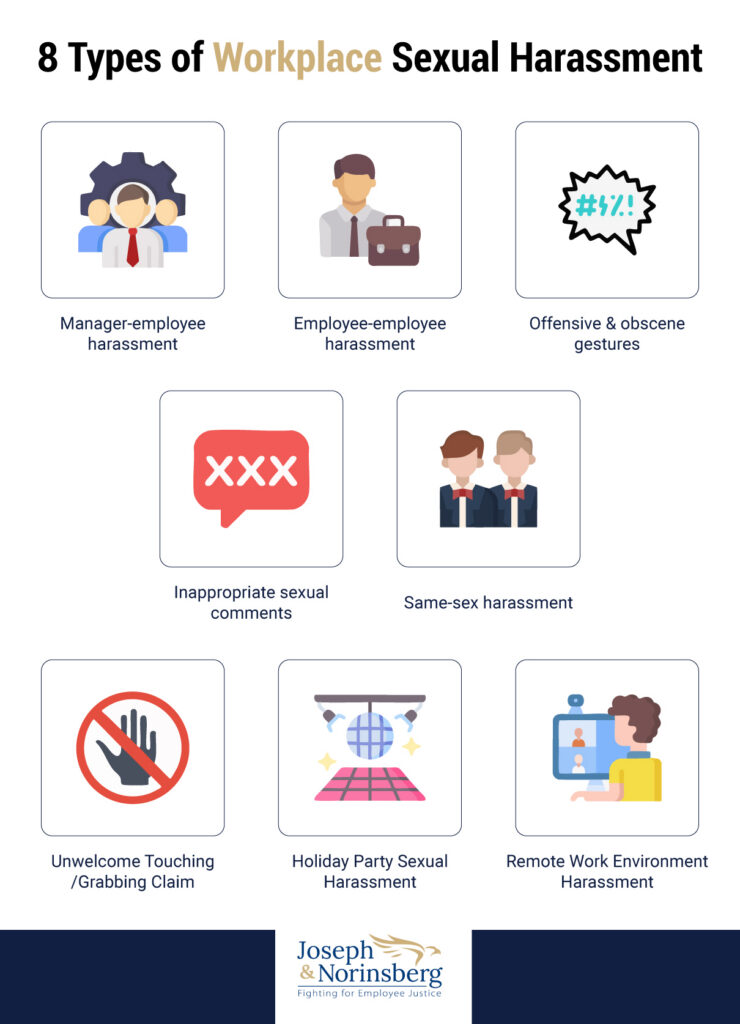
Don’t hesitate to speak out if you have felt victimized in the New York City workplace. The earlier you speak with an NYC sexual harassment lawyer the better. Some forms of workplace harassment include:
- Manager-employee harassment
- Employee-employee harassment
- Offensive & obscene gestures
- Inappropriate sexual comments
- Same-sex harassment
- Manager-Employee Harassment
- Unwelcome Touching/Grabbing Claim
- Holiday Party Sexual Harassment
- Remote Work Environment Harassment
There are formal and informal steps you can take to shed light on any form of sexual harassment in the workplace. Formal steps such as filing a lawsuit with a New York City sexual harassment lawyer may be your best option, but you can try informal actions first if you feel comfortable doing so. First, if you feel safe, let the harasser know you find his or her conduct offensive. In cases where sexual harassment is an inappropriate comment or joke, this course of action may work best to stop the problem before it escalates. If sexual harassment doesn’t stop here, at least you let the offender know what you were feeling.
How To File a Formal Sexual Harassment Complaint in NYC | 2026
If you can’t resolve the issue at this stage or want to avoid further workplace tension, follow your employer’s procedures for reporting workplace sexual harassment in New York City. The human resources departments of most companies have detailed processes for these situations and can help you. Speak to someone in charge of this in your department, and start the paperwork or steps necessary to file a formal complaint. Follow the procedure exactly, documenting on paper every instance of harassment you’ve suffered so far, including dates, times, what the harasser said or did, and witness information.
File an Administrative Charge
If filing a formal complaint with your company doesn’t put an end to sexual harassment, file an administrative charge with the Equal Employment Opportunity Commission (EEOC) or other appropriate governmental agency. The EEOC has a New York City district office open during regular business hours where you can file a charge in person. It doesn’t accept charges online, but you can send a letter with the necessary information and your signature.
After you file the necessary forms, the EEOC will try to mediate a voluntary settlement between you and your employer. If mediation doesn’t work or your employer refuses, the EEOC will conduct an investigation into the charges. This may include interviewing the harasser, employer, and/or witnesses. The EEOC will give you a Notice of Right to Sue if they can’t determine if your workplace violated the law or if you can’t reach a settlement with help from the EEOC.
Can I Sue For Sexual Harassment in New York?
Yes, after the EEOC gives you the Right to Sue letter, you can bring a civil lawsuit against your harasser and/or company for damages you suffered due to sexual harassment. Don’t hesitate to contact an attorney prior to this step for expert legal counsel throughout the necessary steps. Once you’ve decided litigation is the best or only way to seek justice for sexual harassment in the workplace, get in touch with Joseph & Norinsberg. The experienced and compassionate New York City sexual harassment lawyers.
What Damages Are Available For Workplace Sexual Harassment in NY?
New York law recognizes that workplace sexual harassment causes more than just professional disruption. It can impact a person’s financial stability, mental health, and long-term career. As a result, employees who experience sexual harassment at work in NY may be entitled to compensation that reflects the full scope of harm they suffered. Depending on the circumstances of the case, recoverable damages may include:
- Income loss and career-related harm: If harassment led to reduced hours, termination, missed promotions, or forced resignation, an employee may seek compensation for lost income, employment benefits, commissions, and future earning capacity.
- Compensation for emotional harm: Sexual harassment often leaves lasting emotional effects, including stress, anxiety, loss of confidence, and disruption to daily life. New York allows individuals to pursue damages for emotional suffering caused by a hostile or abusive work environment, even when the misconduct was not physically violent.
- Punitive Damages: When an employer’s conduct shows willful disregard for employee rights (such as ignoring complaints, protecting the harasser, or allowing misconduct to continue) punitive damages may be available to hold them accountable and discourage similar behavior.
- Reimbursement for Related Expenses: Employees may recover costs connected to the harassment, including therapy or counseling, medical care, job search expenses, or other financial losses tied directly to the employer’s unlawful actions.
- Legal Fees: Under New York law, successful claimants may recover attorneys’ fees and litigation expenses, helping ensure that access to justice is not limited by financial barriers.
The damages available in a workplace sexual harassment case depend on multiple factors, including how the harassment occurred, how the employer responded, and whether the claim is pursued under New York State law, the New York City Human Rights Law, or both. An experienced New York sexual harassment lawyer can help evaluate potential compensation and guide you through the next steps while prioritizing your privacy and well-being.
What is the Time Limit to File a Sexual Harassment Claim in New York?
There’s a time limit for filing a charge of sexual harassment in New York. You must file the charge with the EEOC within 180 days of the date of the harassment or law violation, but this deadline extends to 300 days if a state or local anti-discrimination law covers your charge.
NYC Sexual Harassment Lawyers That Fight
If you or someone you know is a victim of sexual harassment at work, work with a New York City sexual harassment lawyer at Joseph & Norinsberg that will fight for you every step pof the way. We offer a free initial consultation to discuss your case. Call 212-227-5700 or contact us online today.
What Our Clients Say

Our clients benefit from our hard work, and it means everything to us when they write to us and tell us how much of a difference we made in their lives. Below are a few examples of the types of client feedback we regularly receive:
When other lawyers took a week to get back to me, Joseph & Norinsberg responded within minutes of submitting a request for a case evaluation. Seriously, within eight minutes, I was on a call with an attorney. This law firm is beyond exceptional. From the moment I got on a call with them, I could tell their firm knew what they were doing. Candid, competent, highly educated, professional, and committed—are just a few words I can use to describe their team. Oh, and they won my case!
– Chris S.
Impeccable attention paid to my needs in matters that were very sensitive and extremely emotional. I was guided effectively and brilliantly. I always felt that the highest principals guided every step taken on my behalf. I would wholeheartedly recommend Jon Norinsberg and Erica Meyer of Joseph & Norinsberg to anyone needing their legal expertise, together with the hearts of compassionate human beings who have the ability to fight hard for the justice their clients deserve.
– Lawrence H.
I worked with Bennitta years ago, and she was exceptional. She helped handle a complex issue and was able to get a very favorable outcome. I have referred many people and will continue to do so. Bennita is direct, sets clear expectations, and is very knowledgeable with all aspects of how to navigate the case as well as the legal system. I Highly recommend Joseph & Norinsberg for any employment issues.
– Michael M.
Frequently Asked Questions About Workplace Sexual Harassment
What Are Examples of Subtle Sexual Harassment in The Workplace?
Although some types of workplace sexual harassment are blatant, such as groping the breasts or buttocks, most instances of misconduct are more subtle. As long as the action is repetitive, and serious enough to make the victim uncomfortable, it likely constitutes sexual harassment. Some common examples of subtle sexual harassment include:
- Discussing topics of a sexual nature in front of the victim;
- Repeated comments about the victim’s appearance or attractiveness;
- Circulating or displaying nude or sexually suggestive images;
- Making sexual jokes in ear shot of the victim;
- Spreading rumors of a sexual nature about the victim; and
- Repeated instances of unwanted touching, including hugging, and touching the victim’s shoulder or back.
Am I Being Sexually Harassed at Work?
Sexual harassment includes unwanted touching, unwelcome advances and comments of a sexual nature, as well as requests for sexual favors. But it also includes many less obvious behaviors, some of which don’t even have to be sexual in nature. For example, even making an offensive comment about a person’s gender can be a form of sexual harassment.
The key is that for unwelcome actions and remarks to be considered unlawful, they must be frequent and severe enough to create a hostile work environment. If a “reasonable person” would consider the behavior to be unwelcome and sexual, or related to the victim’s sex, it may be sexual harassment. In making a claim, it is important to be aware of what constitutes sexual harassment. An experienced NYC sexual harassment lawyer can evaluate your case and help you determine how to proceed.
Is Sleeping With Your Boss To Keep Your Job Sexual Harassment?
When an imbalance of power is involved in a workplace sexual relationship, the question of whether or not the relationship is considered “welcome” by both parties must be answered. Even if there is no explicit threat, such as “sleep with me or you’ll lose your job,” courts may rule that sex was non-consensual when it is believed that the victim felt they had no choice in the matter. In addition to explicit and implied threats, bribery is a common power play involved in workplace sexual harassment. If a supervisor says something like, “I’ll forgive your poor performance this month if you go out with me,” this constitutes sexual harassment in the form of a bribe.

Bennitta Joseph is a dedicated New York City sexual assault attorney with experience litigating cases involving workplace harassment. She takes on cases with uncompromising dedication, patience, and a relentless desire to achieve justice.
- New York Hostile Work Environment Lawyer
- New York Manager Workplace Harassment Lawyer
- New York Obscene Gesture Lawyer
- New York Same Sex Harassment Lawyer
- New York Sexual Comments Lawyer
- New York Sexual Harassment Lawyer
- New York Unwelcome Touching Lawyer
- New York Verbal Abuse Lawyer
- Brooklyn Workplace Sexual Harassment Lawyer
- Manhattan Workplace Sexual Harassment Lawyer
- Queens Workplace Sexual Harassment Lawyer
"Bennitta is an amazing attorney, if you have a sexual harassment case… She's your go to attorney! Very responsive, answers all your questions in a timely manner, makes sure you're very informed on what you're getting into & what the possible outcomes are."
Nigel Antonio
"Joseph and Norinsberg are excellent attorneys and a credit to the bar. It is a testament to their advocacy and skill, that as a fellow lawyer I consistently refer clients to them for help in all workplace and employment related issues."
Christopher Galiardo
"Thank you very much to the lawyers of this firm, they have treated me very well. I felt like I was their only customer. Always returning my calls and being attentive to everything related to my case. I think this company has done a great job."
Narda Liliana Martinez Rey
Sexual harassment case against a luxury brand in the fashion industry (confidential).
Secured compensation for several years of lost wages, and emotional distress, and compensation for the physical assault.
Sexual harassment case settled against a large bio-tech company.