

Dealing with age discrimination in the workplace is exhausting. Although taking action to hold your employer accountable can feel empowering, filing a lawsuit can be overwhelming in its own right.
Read on for a clear, step-by-step guide on how to file a lawsuit for age discrimination from the trusted New York employment lawyers at Joseph & Norinsberg.
When Can You File an Age Discrimination Lawsuit?
Any worker who believes they’ve experienced unfavorable treatment based on age or another protected characteristic can file a charge with the U.S. Equal Employment Opportunity Commission, or EEOC. To pursue an age discrimination lawsuit under federal law, you must first file an official charge with the EEOC.
In some states, including New York, New Jersey, and Massachusetts, you can file a discrimination lawsuit under state law directly with state courts instead of going through a government agency first. State laws often include stronger and more accessible worker protections, so consider consulting an experienced employment lawyer to understand which legal option is best for you.
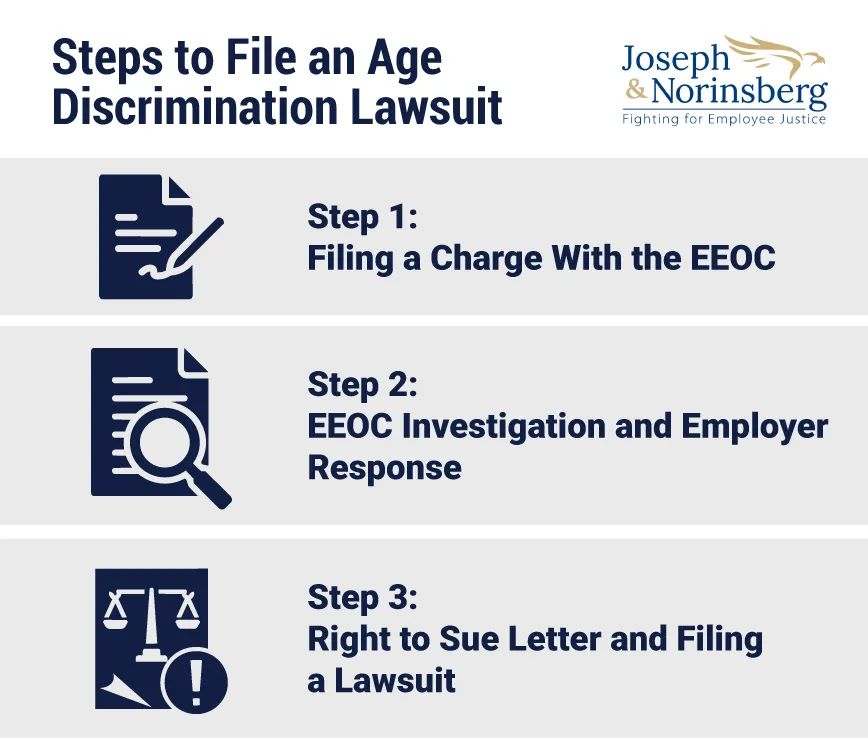
Step 1: Filing a Charge With the EEOC
You can file a charge with the EEOC online, in person at a local office, or through the mail.
Your general must file a complaint within 180 days of an incident of discrimination. However, if a state law in your jurisdiction prohibits age discrimination in employment, and a state agency enforces that law, you have up to 300 days to file a charge.
Step 2: EEOC Investigation and Employer Response
Once the EEOC receives your charge, it will send a copy to your employer and request a written response. It may attempt to mediate a resolution between you and your employer before beginning its investigation.
If mediation is unsuccessful or unattempted, the EEOC will assign an investigator to your case. The investigator will request documents from both parties and conduct interviews with you, your employer, and key witnesses. Once the agency determines whether your employer violated discrimination laws, it will send a letter documenting its findings to both parties.
Step 3: Right to Sue Letter and Filing a Lawsuit
If the EEOC finds in your favor, it will attempt to help you settle your claims with your employer. If talks are unsuccessful or the investigation uncovers no proven violations, the commission will send you a Notice of Right to Sue letter that allows you to file a lawsuit against your employer in federal court. Once you receive the letter, you have 90 days to file suit.
How Long Does an Age Discrimination Lawsuit Take?
On average, the EEOC takes about 10 months to investigate a workplace discrimination complaint. After that, your lawsuit might take years to work its way through the court system, depending on the complexity of your case, the strength of available evidence, and the court’s backlog.
Reaching a settlement agreement with your employer at any point can bring your case to a much quicker resolution than going to trial. An experienced discrimination lawyer can estimate the timeline of your case and work to secure a fair settlement.
What Evidence Helps Strengthen Your Case?
Direct evidence of discriminatory intent is hard to find, so your case will likely depend on circumstantial evidence. Combining multiple sources of evidence can paint a clearer picture of age discrimination and help you prove your claims. Important types of evidence include:
- Written statements or communications from your employer
- Your own contemporaneous notes
- Workplace policies or other documents
- Statements from witnesses
- Records showing patterns of behavior by your employer
How Can a Lawyer Help With an Age Discrimination Claim?
If your employer has discriminated against you because of your age, consider consulting with a lawyer as soon as possible. An experienced employment law attorney can provide professional guidance through any stage of an age discrimination claim, whether you’re about to file a lawsuit or still need to report your experiences to HR.
Your lawyer can help you gather evidence to build a strong case, meet all relevant filing deadlines, and understand what legal options are available to you at each step. They can also represent you through the EEOC’s investigation, mediation, or settlement process, negotiating to maximize your compensation and achieve the results you deserve.
Ready to Take the Next Step in Your Age Discrimination Case? Contact Joseph and Norinsberg
With more than 75 years of combined experience representing workers, the Joseph & Norinsberg team is ready to fight relentlessly to protect your rights. Our age discrimination lawyers have extensive knowledge of employment law and a long track record of holding companies accountable for mistreating their employees.
Don’t suffer in silence for another day. Contact us online or call 212-227-5700 today to schedule a free consultation.
